Professor Tianzi Jiang Receives the Lifetime Achievement Award from the Organization for Human Brain Mapping
Font:【B】 【M】 【S】
The Annual Meeting of the Organization for Human Brain Mapping (OHBM) was held in Bordeaux, France, from June 14 to 18, 2026. On the afternoon of June 14 local time, the award ceremony took place during the opening ceremony. Professor Tianzi Jiang, a researcher at the Laboratory of Brain Atlas and Brain-inspired Intelligence, Institute of Automation, Chinese Academy of Sciences, received the highest honor of the Society—the Lifetime Achievement Award, also known as the Glass Brain Award.
This marks the first time since the establishment of the award in 2014 that it has been presented to a scientist from outside Europe and North America. It is also the first time that a Chinese scientist has received this honor, reflecting the international academic community’s high recognition of China’s contributions to the field of brain mapping.
OHBM is the world’s most authoritative international academic organization in the field of human brain mapping, and its annual meeting is the largest academic conference in this area. As the highest individual honor conferred by OHBM, the Glass Brain Award is granted to only one recipient each year. It recognizes leading scholars who have made original and paradigm-shifting contributions to the study of human brain structure and function using neuroimaging technologies.
Professor Tianzi Jiang has devoted more than two decades to research in brain imaging and brain mapping, and proposed the Brainnetome research framework. Guided by this framework, he overcame key limitations in traditional brain atlas construction and proposed a new concept of mapping the brain based on brain connectivity. He established the theory and methodology for a new generation of brain atlases and developed the Human Brainnetome Atlas, laying an important foundation for brain-computer interfaces.
Building on this work, Professor Jiang led his team in developing a neuromodulation system guided by the Brainnetome Atlas. To enable precise neuromodulation therapy for brain disorders that can be delivered “anytime, anywhere, and on the go,” the team developed a wearable repetitive transcranial magnetic stimulation device with independent intellectual property rights. This device can support large-scale application and home-based treatment, thereby transforming the therapeutic paradigm for neurological and psychiatric disorders.
In the area of brain-control technologies, Professor Jiang and his team developed an integrated near-infrared and electroencephalography imaging system, known as NEG, providing a new device platform for non-invasive brain-computer interfaces. Over the past decade, Professor Jiang has focused on addressing major bottlenecks in brain-computer interfaces and brain disorder research from the perspective of Brainnetome studies. He has achieved a series of breakthroughs in the Brainnetome Atlas, digital twin brain platforms, and next-generation brain-computer interface methods and devices, while actively promoting the industrial development of brain science and brain-computer interfaces.
As a former Chair of OHBM, Professor Jiang has also worked to break down geographical and disciplinary barriers, promote equal academic exchange among brain mapping scholars worldwide, and support young researchers from developing countries in participating in international collaborative research in human brain mapping. His efforts have made important contributions to the development of the Society.
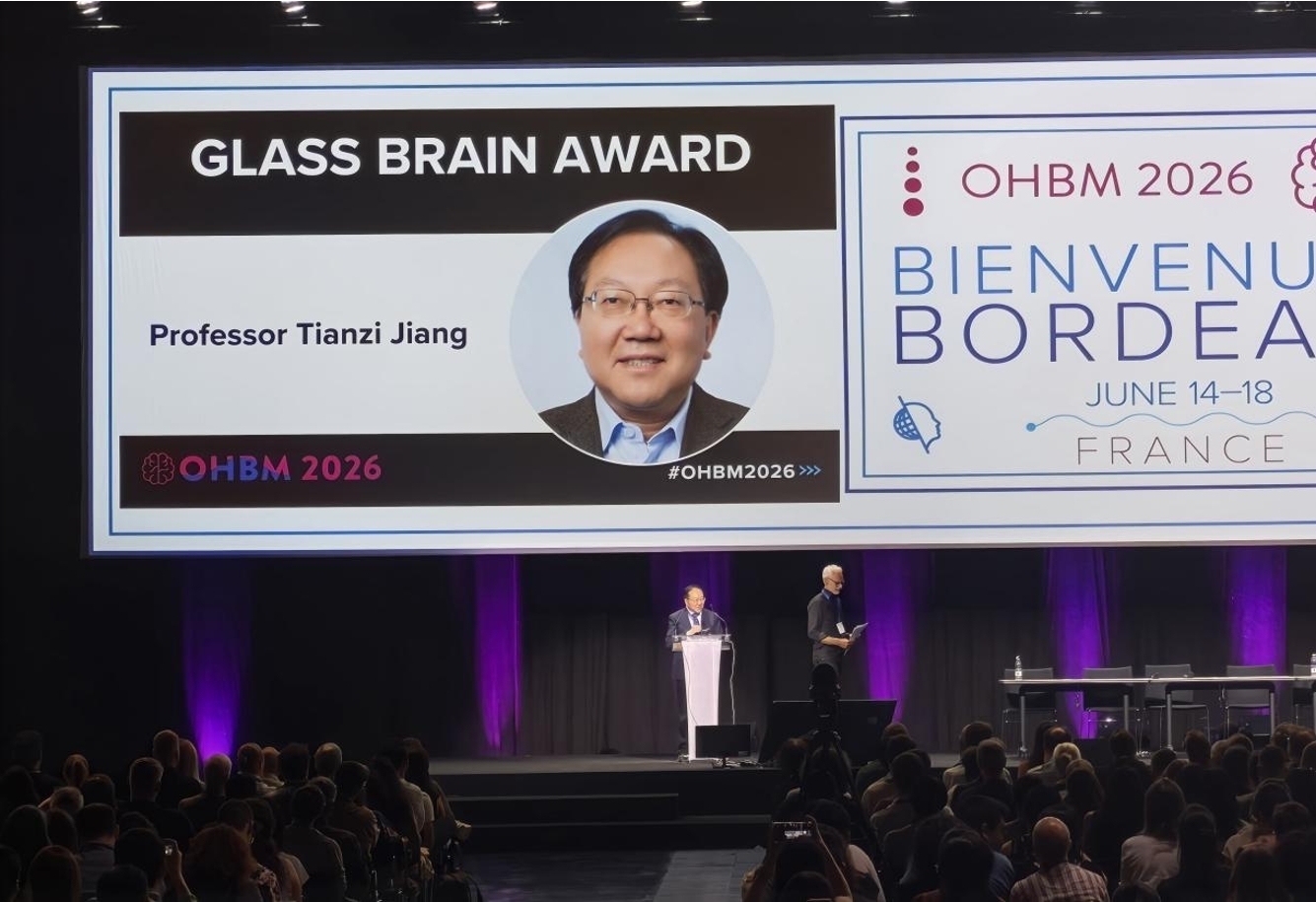
Professor Tianzi Jiang at the award ceremony
Copyright Institute of Automation Chinese Academy of Sciences All Rights Reserved
Address: 95 Zhongguancun East Road, 100190, BEIJING, CHINA
Email:brain-ai@ia.ac.cn
