A Novel Neural Network Framework CATS Net: Achieving Human-like Concept Formation, Understanding, and Communication
Font:【B】 【M】 【S】
A unique capability of human intelligence is its ability to abstract concepts from sensory experiences, enabling thinking and communication directly within conceptual spaces independent of sensory input. It is generally believed that this bidirectional process—compressing high-dimensional perceptions into low-dimensional concepts and reconstructing perceptions from these concepts—forms the foundation of human symbolic thinking and thus supports the emergence of language. However, current artificial intelligence (AI) systems struggle to realize this process. Traditional deep networks typically entangle knowledge within vast parameters, making it challenging to extract independent concepts. Furthermore, popular large AI models rely heavily on existing human linguistic symbols for training and fail to spontaneously form concepts directly from perceptual experiences. This remains a critical distinction between AI and human cognition.
Recently, the research teams led by Shan Yu at the Laboratory of Brain Atlas and Brain-inspired Interlligence, Institute of Automation, Chinese Academy of Sciences, and Yanchao Bi at the School of Psychological and Cognitive Sciences, Peking University, achieved a significant breakthrough to address this issue. The research proposed a novel neural network framework, named CATS Net, capable of human-like concept formation, understanding, and communication. Interestingly, the conceptual space spontaneously formed by this neural network significantly resembles the conceptual space constructed by human language, and its concept representations show substantial correlation with those in the human brain. This study provides a computational model for understanding human conceptual cognition and lays the groundwork for developing AI systems with human-like conceptual intelligence. The results have been published online in the international academic journal Nature Computational Science.
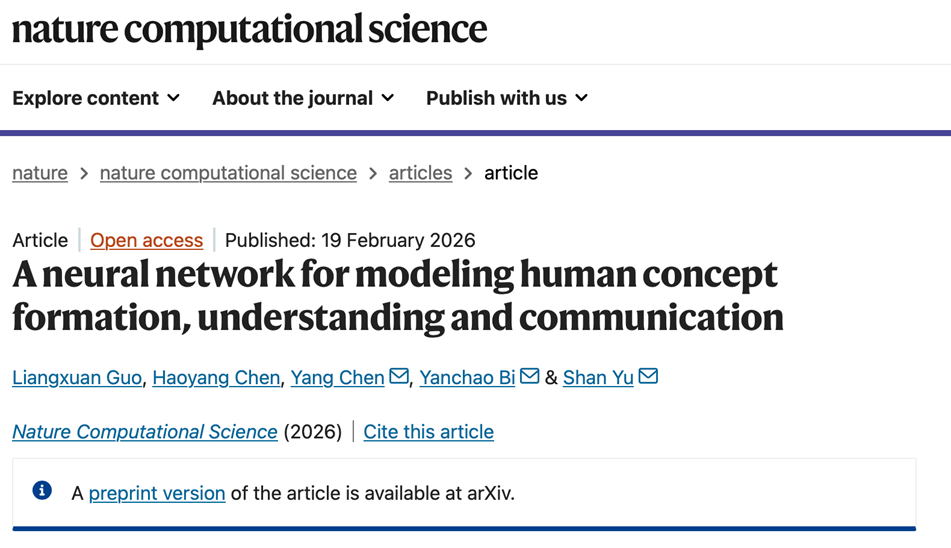
Two core modules replicate human conceptual generation, understanding, and communication.
CATS Net comprises two core modules: the Concept Abstraction (CA) module and the Task Solution (TS) module.
When addressing visual tasks, the CA module spontaneously compresses high-dimensional visual inputs into compact, low-dimensional "concept vectors." These concept vectors act like keys, generating a series of "switch" signals through a hierarchical gating mechanism, dynamically modulating the neural activity in the TS module. This efficiently and flexibly guides task-specific visual perception, mirroring human concept formation and understanding.
The system autonomously generates numerous new concepts through environmental interactions, forming its own conceptual space. When the conceptual spaces of different neural networks align, knowledge can be transferred directly through concept vectors without environmental learning, simulating human symbolic communication through language.
Unveiling computational principles behind human conceptual cognition.
The research team compared the spontaneously formed conceptual representations of CATS Net with human conceptual spaces and neural activity data.
Representational Similarity Analysis (RSA) of functional magnetic resonance imaging (fMRI) revealed that the conceptual space generated by CATS Net aligns closely with psychological models of human cognitive semantics and significantly correlates with the neural activity patterns in the ventral occipitotemporal cortex, an area responsible for visual-semantic representation. Additionally, the dynamic gating mechanism in the CA module resembles neural activity patterns of the semantic control network in the human brain, associated with concept extraction and manipulation. This indicates that CATS Net not only functionally simulates human conceptual cognition but also reveals computational mechanisms underlying concept formation and understanding in the human brain.
CATS Net is inspired by the Context-Dependent Processing (CDP) model, based on the frontal lobe, suggesting a pivotal role of the frontal lobe and CDP in human conceptual cognition.
Foundation for developing next-generation intelligent systems.
This research lays an essential foundation for developing next-generation intelligent systems capable of human-like conceptual formation and application.
Currently, large language models remain limited by human-defined linguistic categories. Granting them the ability to autonomously form new concepts holds promise for broader applications, such as novel scientific explorations. However, ensuring alignment with human values after granting such capabilities will become the crucial next step.
The first co-authors of this study are Liangxuan Guo, a doctoral student at the Institute of Automation, Chinese Academy of Sciences, Haoyang Chen, a doctoral student at Peking University, and Yang Chen, an associate researcher at the Institute of Automation, Chinese Academy of Sciences. Corresponding authors are Shan Yu from the Institute of Automation, Yanchao Bi from Peking University, and Yang Chen from the Institute of Automation. The research was supported by the CAS Young Scientists in Basic Research Program, the National Natural Science Foundation of China, and CAS Strategic Priority Research Program.
Copyright Institute of Automation Chinese Academy of Sciences All Rights Reserved
Address: 95 Zhongguancun East Road, 100190, BEIJING, CHINA
Email:brain-ai@ia.ac.cn
