New Study Uncovers How the Brain Generalizes From One Case to Another, Resolving the Stability–Flexibility Trade-off in Learning
Font:【B】 【M】 【S】
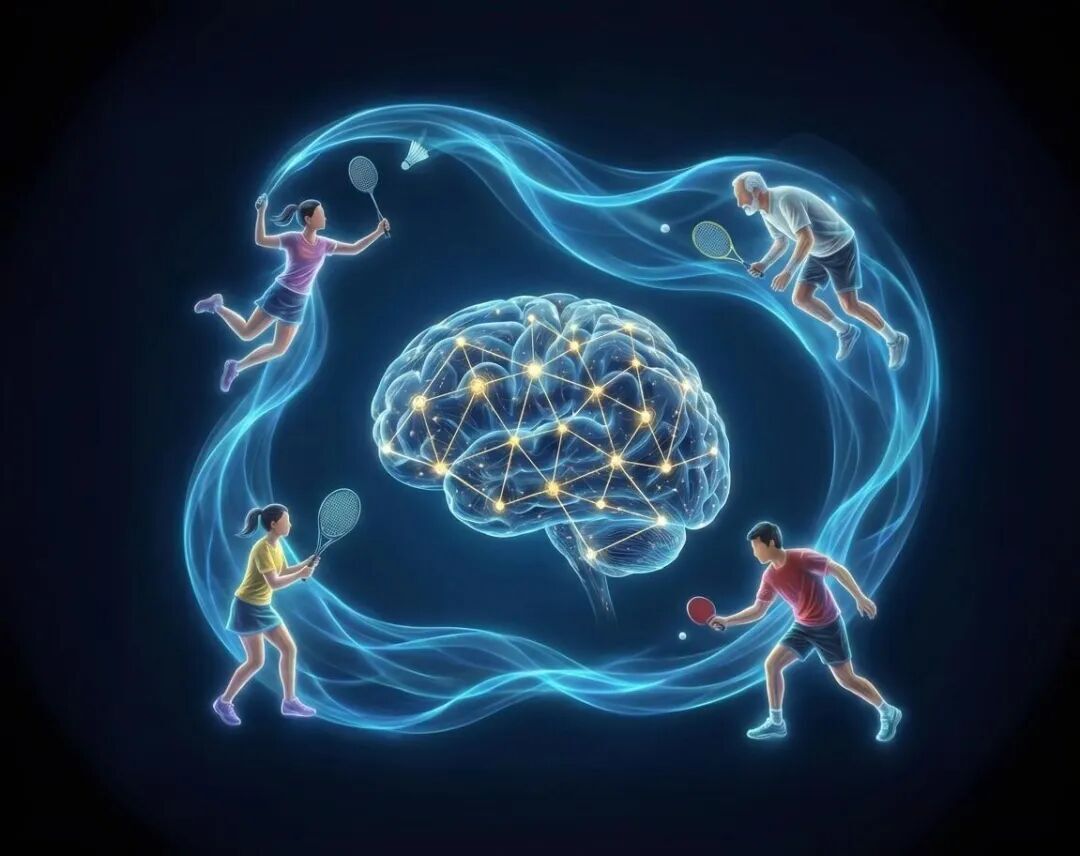
Skilled tennis players often pick up other ball sports—such as badminton or table tennis—much faster; once you master one problem-solving strategy, you can quickly apply it to similar problems. This ability to “learn by analogy” is one of the most fascinating traits of human intelligence. It is not simply the accumulation of memories, but a higher-level capacity known as “learning to learn”: the brain can extract common principles underlying tasks and efficiently reuse them in new contexts. The neural basis of this capacity lies in stable, reusable patterns of neural activity formed during learning—what psychology refers to as “schemas.” However, how the brain simultaneously reuses existing knowledge while flexibly adapting to new task conditions has long remained a mystery.
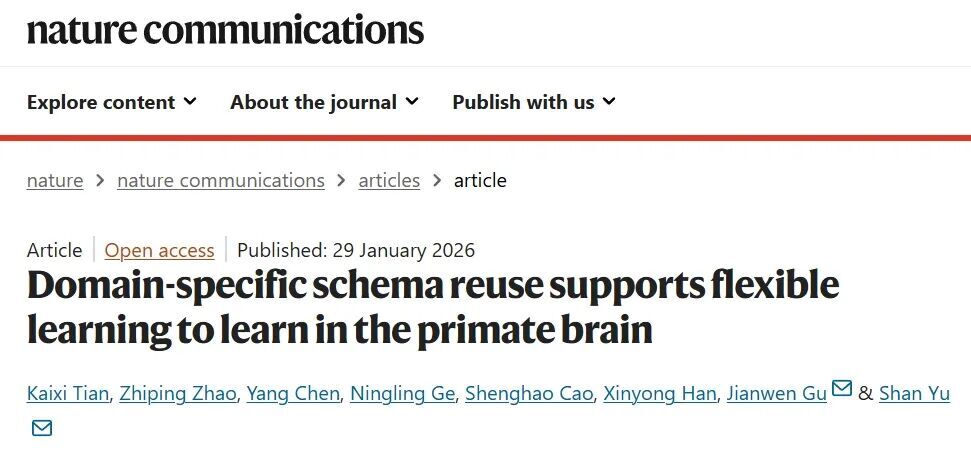
Recently, the Institute of Automation, Chinese Academy of Sciences, together with the Ninth Medical Center of the PLA General Hospital and The First Hospital of Jilin University, provided an important answer to this question. The study, for the first time, found that neural activity in the primate brain forms two nearly orthogonal representational spaces: one responsible for encoding stable schematic structure, and the other for encoding task-specific features that vary with concrete conditions. This neural organization offers an elegant solution to the long-standing challenge of balancing stability and flexibility during learning. The findings were published in Nature Communications.
The research team used macaque monkeys as experimental subjects and trained them to perform a series of visuomotor mapping tasks. The results showed that as training progressed, the monkeys’ learning speed in subsequent tasks of the same type increased significantly, demonstrating a clear “learning by analogy” effect. This indicates that, like humans, primates can extract abstract task structure and transfer it to new problems.
Further neural recordings revealed that within population activity in the macaques’ dorsal premotor cortex (PMd), the brain spontaneously formed two representational spaces that were almost mutually orthogonal. One was a stable “decision subspace,” containing a low-dimensional neural manifold that encodes the core decision logic of the task. Even when the specific visual stimuli changed, as long as the decision rule remained the same, the brain reused this stable neural pattern. The other was a relatively independent “sensory subspace,” dedicated to encoding the specific sensory features of the current task, enabling adaptation to new external conditions. This near-orthogonal neural organization allows stable knowledge and new information to operate in different representational spaces, minimizing interference. In other words, the brain achieves stable storage and flexible updating of knowledge through “representational space separation.”
These findings not only deepen our understanding of learning mechanisms in the primate brain, but also provide important inspiration for artificial intelligence. Current deep learning systems often suffer from “catastrophic forgetting” when learning multiple tasks sequentially—learning a new task interferes with knowledge from earlier tasks. In contrast, by constructing mutually orthogonal representational spaces, the primate brain enables both isolation and reuse of knowledge. Adapting this strategy may offer a new design approach for next-generation AI systems capable of fast learning and flexible adaptation.
The study’s co–first authors are Tian Kaiqian, a PhD student at the Institute of Automation, Chinese Academy of Sciences; Zhao Zhiping, a physician at The First Hospital of Jilin University; and Chen Yang, an associate researcher at the Institute of Automation, Chinese Academy of Sciences. The co-corresponding authors are Yu Shan, a researcher at the Institute of Automation, Chinese Academy of Sciences, and Gu Jianwen, a professor at the Ninth Medical Center of the PLA General Hospital. This work was supported by the National Science and Technology Innovation 2030 Major Project on “Brain Science and Brain-Inspired Research,” as well as the Chinese Academy of Sciences Strategic Priority Research Program and other funding sources.
Copyright Institute of Automation Chinese Academy of Sciences All Rights Reserved
Address: 95 Zhongguancun East Road, 100190, BEIJING, CHINA
Email:brain-ai@ia.ac.cn
