Topographic Representation of Fine-Grained Emotions in the Human Brain Revealed by a Fundamental Affective Space
Font:【B】 【M】 【S】
Recently, the Neural Computation and Brain-Computer Interaction Team of the Laboratory of Brain Atlas and Brain-inspired Intelligence used machine learning methods and neuroimaging data to construct a fundamental affective space of the human brain, revealing fine-grained emotion encoding patterns under natural visual stimulation. The related research, titled Topographic representation of visually evoked emotional experiences in the human cerebral cortex, was published in the Cell Press journal iScience.
There has long been a debate between “localization theory” and “construction theory” about the spatial representation of emotional experience in the human brain. Uncovering the neural mechanisms of human emotional experience has been a central topic in affective neuroscience. Early studies of emotion representation in the brain focused on the six basic emotion categories identified by Ekman from human facial expressions (happiness, sadness, anger, disgust, fear, surprise). In recent years, psychological research has shown that humans can express much more fine-grained emotion categories, such as Admiration and Adoration.
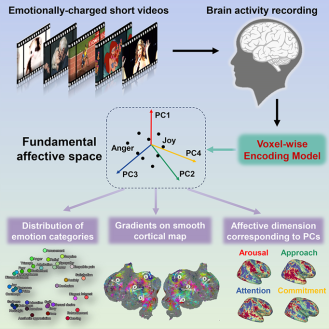
Although prior studies proposed a localizationist theory—that discrete emotion categories are independently encoded in specific brain regions—this theory struggles to explain how finer-grained emotion categories are represented neurally. To address this question, the research team combined natural visual stimulus-driven neuroimaging data to build voxel-level neural encoding models, from which they extracted the brain’s fundamental affective space and, based on this, decoded the encoding patterns of 27 fine-grained emotion categories in the cortex. They found that encoding of fine-grained emotion categories is widely distributed across multiple cortical regions. At the same time, the fundamental affective space of the brain reveals continuous gradient-like encoding patterns for fine-grained emotions across the cortex, patterns that can be partly explained by another emotional framework: the affective dimensions model.
Research Framework
This study provides new insights into the neural mechanisms of fine-grained emotional experience, offers new evidence supporting constructionist theories of emotion representation in the brain, and helps reconcile the debate between emotion categories and affective dimensions models within the fundamental affective space. Looking forward, this work also provides an effective theoretical foundation for developing brain-inspired affective intelligence models and for improving large models’ capacity for emotional understanding.
The paper lists Associate Researcher Du Changde and PhD student Fu Kaicheng of the Laboratory of Brain Atlas and Brain-inspired Intelligence as co–first authors, with Researcher He Huiguang as the corresponding author. Dr. Wen Bincheng from the Center for Excellence in Brain Science and Intelligence Technology, Chinese Academy of Sciences, also participated in the study. This research was supported by the Ministry of Science and Technology's Science and Technology Innovation 2030 "New Generation Artificial Intelligence" Major Project, the National Natural Science Foundation, and the CAAI–Huawei MindSpore Academic Reward Fund and Intelligent Base Program. To promote continued development in the field, the research team has open-sourced the code and associated datasets.
Paper link:https://www.cell.com/iscience/fulltext/S2589-0042(23)01648-6
Code and data link:https://osf.io/9uyn2/
Copyright Institute of Automation Chinese Academy of Sciences All Rights Reserved
Address: 95 Zhongguancun East Road, 100190, BEIJING, CHINA
Email:brain-ai@ia.ac.cn