Brainnetome Research Center Reveals New Mechanism for Improving Individual Mood States via Intracranial Electrical Stimulation
Font:【B】 【M】 【S】
According to World Health Organization data, over 350 million people worldwide suffer from depression. Many patients are resistant or intolerant to traditional treatments, making mood disorders among the most frequent and difficult conditions to treat and prone to relapse. Understanding the neural mechanisms of emotion regulation is therefore critical for developing effective treatment strategies.
On July 17, 2023, the Brainnetome Research Center of the Laboratory of Brain Atlas and Brain-Inspired Intelligence at the Institute of Automation, Chinese Academy of Sciences, led by Researcher Jiang Tianzai, for the first time revealed at fine spatiotemporal resolution the neuro-electrophysiological mechanisms by which intracranial electrical stimulation (iES) of the orbitofrontal cortex (OFC) can improve individual mood states in specific emotional conditions. This study is of great significance for developing more precise and effective treatments for mood disorders and offers real hope of improving patients’ quality of life. The findings were published in Brain Stimulation under the title State-specific modulation of mood using intracranial electrical stimulation of the orbitofrontal cortex.
Intracranial electrical stimulation (iES) is a promising tool for treating treatment-resistant mood disorders. Recent studies have increasingly focused on the orbitofrontal cortex (OFC), a brain region crucial for emotional processing and a key player in signaling "non-reward" in mood disorders. While some studies have shown that iES of the OFC can improve mood, questions remained about whether OFC stimulation is more effective than stimulation of other emotion network regions, whether its effect depends on the individual's current mood state, and what its underlying neural mechanisms are.
To address these questions, the research team employed advanced intracranial EEG analyses and machine learning models to systematically investigate the optimal target, timing, and neural mechanisms of iES for improving mood (see Figure 1). Data were collected from 24 epilepsy patients implanted with intracranial electrodes within the emotion network and receiving iES treatment.
The study found that the neural electrophysiological mechanism by which iES of the OFC improves mood can be summarized as "the right place, the right time, doing the right thing."
“The Right Place”: Only OFC stimulation effectively improved mood. Baseline intracranial EEG and mood ratings revealed that decreased delta-theta power in the OFC predicted improved mood. Mood ratings during iES showed that only OFC stimulation improved mood scores compared to other targets. iES of the OFC specifically suppressed delta-theta power, confirming it as the optimal target for mood regulation.
“The Right Time”: Only in low-mood states did OFC stimulation effectively improve mood. The researchers trained a machine learning model to predict individual mood states from baseline OFC delta-theta power. They found that only when this model predicted a low mood state did OFC stimulation suppress delta-theta power and improve mood. This defined the optimal timing for OFC-targeted iES (see Figure 2).
“Doing the Right Thing”: OFC stimulation increased information transfer within the emotion network. Analyses revealed that iES of the OFC led to local low-frequency power suppression and high-frequency power increases. It also enhanced cross-region information transfer within the emotion network (see Figure 3).
In summary, this study systematically revealed, at fine spatiotemporal resolution, a new mechanism by which OFC-targeted iES improves individual mood states. These findings offer important new insights into the neural basis of emotion regulation via iES and could help optimize its clinical application to better treat mood disorders.
The paper's first authors are Associate Researcher Cao Dan of the Institute of Automation, CAS, and Liu Qihong (Master’s graduate) from University of Electronic Science and Technology of China. Researcher Jiang Tianzai and Associate Researcher Li Jin served as co-corresponding authors, and PhD student Zhang Jiaqi of the Institute also participated. The study was funded by the National Key R&D Program (2021ZD0200200), National Natural Science Foundation of China (32271085, 82151307), the Open Project of the State Key Laboratory of Cognitive Neuroscience and Learning (CNLYB2004), and major projects of Zhejiang Lab (2022KI0AC02; 2022ND0AN01).
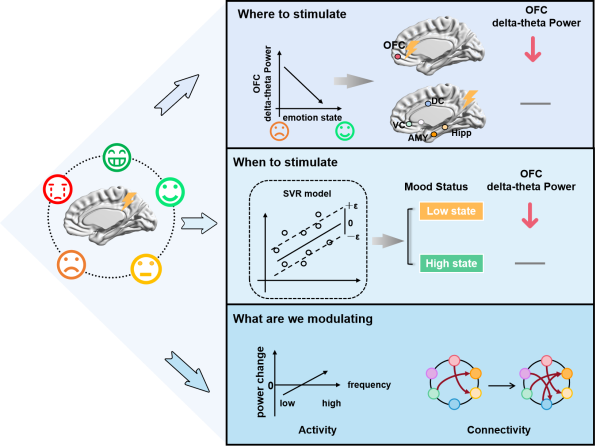
Figure 1. Study Framework: A series of analyses were performed to determine the best strategy for using intracranial electrical stimulation to improve mood. (Top row) Only OFC stimulation was linked to better mood outcomes compared to other regions. (Middle row) A multi-class classifier decoded mood states as “low” or “high”; OFC stimulation modulated neural activity only in “low” states. (Bottom row) OFC stimulation suppressed delta-theta power and increased gamma power locally, while boosting network-wide information transfer.
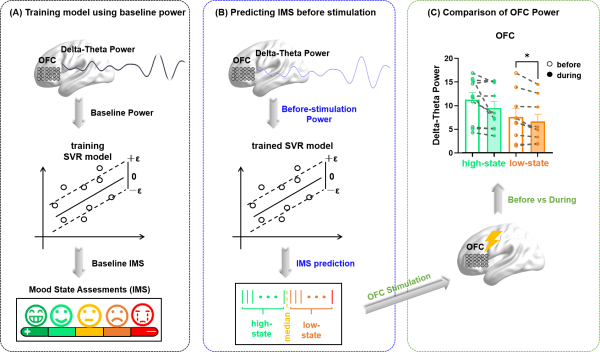
Figure 2. Predicting pre-stimulation individual mood ratings and iES outcomes under different mood states
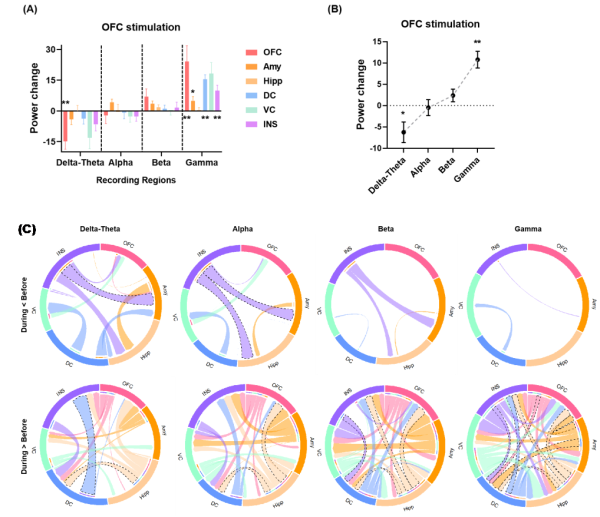
Figure 3. OFC stimulation induces power reorganization across frequency bands and increases inter-regional information transfer within the emotion network
Paper Link:
https://doi.org/10.1016/j.brs.2023.07.049
Copyright Institute of Automation Chinese Academy of Sciences All Rights Reserved
Address: 95 Zhongguancun East Road, 100190, BEIJING, CHINA
Email:brain-ai@ia.ac.cn
