Brain-Inspired Theory of Mind Spiking Neural Network Empowers Multi-Agent Cooperation and Competition
Font:【B】 【M】 【S】
Humans and other social animals commonly exhibit cooperative or competitive behaviors in nature. Theory of Mind (ToM)—the ability to distinguish self from others and infer others’ mental states (including beliefs, intentions, and desires) (see Figure 1A)—plays a crucial role in the emergence of social intelligence within groups. In recent years, this cognitive function has been extensively studied in psychology and cognitive neuroscience, gradually uncovering its neural mechanisms (see Figure 1B). These neural insights offer important inspiration for exploring multi-agent social interaction and human–AI interaction based on Theory of Mind.
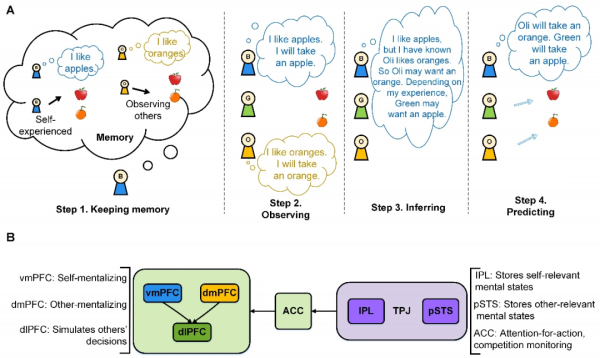
Figure 1. A. Example of Theory of Mind; B. Brain regions and neural circuits involved in Theory of Mind
The Brain-Inspired Cognitive AI Group led by Researcher Zeng Yi at the Laboratory of Brain Atlas and Brain-Inspired Intelligence, Institute of Automation, Chinese Academy of Sciences, drew inspiration from the neural mechanisms of human Theory of Mind to propose a brain-inspired multi-agent Theory of Mind Spiking Neural Network (MAToM-SNN) (see Figure 2). Specifically, inspired by the ventral medial prefrontal cortex (vmPFC) and dorsal medial prefrontal cortex (dmPFC), which respectively internalize and store self-related and other-related information, and the dorsolateral prefrontal cortex (dlPFC), which infers others’ decisions, the model comprises two modules: Self-MAToM (inferring others from self-experience) and Other-MAToM (inferring others from observations). Both modules adopt a four-layer fully connected spiking neural network structure using the leaky integrate-and-fire (LIF) model to simulate neuron spiking. Inspired by the anterior cingulate cortex (ACC), which responds to discrepancies between predicted and actual behaviors of others, the model is trained and optimized using a policy gradient algorithm. Predictions from MAToM-SNN enrich the state representation for the decision model, helping the agent adaptively adjust its strategy.
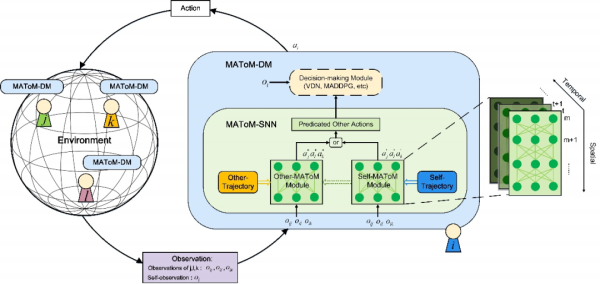
Figure 2. Theory of Mind model enabling efficient cooperation and competition among multiple agents
The research team conducted experiments in multiple cooperative and mixed cooperation–competition scenarios. Cooperative scenarios such as Harvest, Escalation, and Hunt required agents to collaborate to secure greater rewards, while an individual agent could only achieve limited rewards alone. Mixed scenarios like Physical Deception, Predator–Prey, and World Communication involved adversarial interactions, where one side sought to disrupt or evade the other. Results showed that in cooperative settings, the Theory of Mind model helped agents autonomously collaborate, make more forward-looking decisions, and secure greater collective benefits. In competitive settings, the ToM module enabled agents to better understand teammates and opponents, yielding more advantageous team-level behaviors when combined with decision models. Experiments also demonstrated that the Theory of Mind model generalized effectively to decision networks built from both traditional artificial neural networks and spiking neural networks, improving average rewards and learning speed (see Figures 3 and 4).
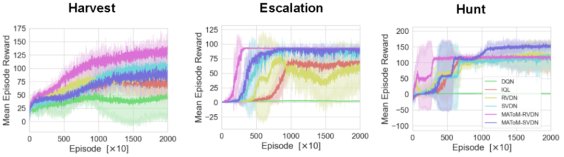
Figure 3. Theory of Mind model boosting multi-agent cooperation

Figure 4. Theory of Mind model enhancing multi-agent competition
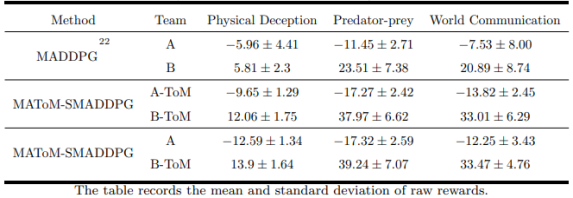
Additionally, the study explored the role of the Theory of Mind model in competitive tasks. Ablation experiments (see Table 1) showed that teams with ToM capability (B-ToM) achieved higher rewards than those without (B). Moreover, when one adversarial team possessed the ToM model (B-ToM), the reward of the opposing team (A) decreased, indicating that Theory of Mind boosts a team's reward while suppressing the opponent's reward. When both teams had ToM models, the team with more agents (Team B) achieved greater rewards and suppressed the opponent more effectively. This confirms that the model can help larger teams improve performance in competitive tasks.
Table 1. Ablation analysis results in competitive tasks
The study further analyzed the influence of self-experience-based and other-observation-based ToM on social decision-making. Results showed that self-experience-based inference helped quickly improve cooperative efficiency in the early stages of interaction, while accumulated observations enabled more accurate direct modeling of others in the later stages (see Figure 5). This indicates that self-experience-based and observation-based Theory of Mind contribute to different stages of social interaction, collaboratively enhancing multi-agent cooperation and competition.

Figure 5. Comparison of performance in competitive tasks between agents with and without self-experience
In summary, this study proposed and implemented a brain-inspired Theory of Mind model that brings Theory of Mind capabilities to multi-agent systems, enabling their application in complex social decision-making. The results demonstrate that ToM enhances efficient cooperation and competition in social interactions, providing a foundation for exploring human–AI interaction and multi-agent social decision-making. Moreover, equipping AI with social cognitive abilities such as Theory of Mind and empathy is fundamental to developing safe, responsible, ethical, and trustworthy AI, fostering harmonious coexistence between humans and AI.
On June 23, 2023, the related work was published online in Cell Press's journal Patterns under the title A Brain-inspired Theory of Mind Spiking Neural Network Improves Multi-agent Cooperation and Competition.
Article Link:
https://www.cell.com/patterns/fulltext/S2666-3899(23)00126-5
Model Code (Open Source):
https://github.com/BrainCog-X/Brain-Cog/tree/main/examples/Social_Cognition/MAToM-SNN
Copyright Institute of Automation Chinese Academy of Sciences All Rights Reserved
Address: 95 Zhongguancun East Road, 100190, BEIJING, CHINA
Email:brain-ai@ia.ac.cn
