Brain-Inspired Cognitive AI Research Group Paper Named One of Cell Press's Most Popular China Papers of 2021
Font:【B】 【M】 【S】
Recently, Cell Press announced its list of 2021 China Annual Papers and Most Popular China Papers. Among them, the paper Brain-Inspired Classical Conditioning Model, published by Yi Zeng’s Brain-Inspired Cognitive AI Research Group at the Laboratory of Brain Atlas and Brain-Inspired Intelligence in the interdisciplinary science journal iScience (Cell Press), was selected as one of the Most Popular China Papers.
Out of 914 papers published by Chinese scholars in Cell Press journals this year, 323 were in the interdisciplinary science category. In this evaluation, 25 papers were shortlisted through preliminary judging in this category, coming from journals including Cell, Chem, Matter, One Earth, Cell Reports Physical Science, iScience, Heliyon, Patterns, and Chem Catalysis. iScience itself selected 9 of its highest-impact papers out of 267 submissions for the interdisciplinary category shortlist. The research paper co-authored by Associate Researcher Yuxuan Zhao (first author), Researcher Yi Zeng (corresponding author), and master's student Guang Qiao ultimately became one of the 5 selected as Most Popular China Papers in the interdisciplinary category.
In this research, Yi Zeng’s team integrated findings from biology, neuroscience, and other disciplines in the study of classical conditioning. Based on the neural underpinnings of conditioning—including the brain regions, circuits, cognitive functions, neuron-scale mechanisms, and computational principles involved—they proposed a brain-inspired spiking neural network model of classical conditioning (see Figure 1). This model consolidates well-established biological insights into a unified brain-inspired spiking neural network. Compared to other computational models, it can reproduce 15 classic conditioning experiments established in neuroscience, offering reasonable computational explanations that help illuminate the neural mechanisms by which organisms establish conditioned reflexes.
Moreover, the model can be deployed on robots, enabling them to exhibit brain-like classical conditioning behavior. Experimental validation demonstrated that the model supports speed generalization: in navigation tasks, a robot can learn a trajectory at low speed via conditioning and later follow it at higher speed without retraining.
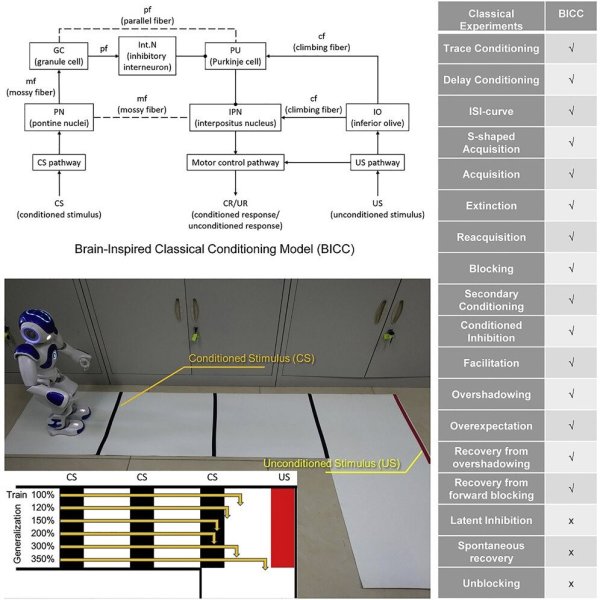
Figure 1
Yi Zeng commented: “Our group is very fond of this work, not only for the progress it represents but also for the wide space it leaves for future exploration.” He elaborated on future plans: “Of the 18 known classical conditioning experiments, our published model can reproduce 15—already the highest coverage of any existing work—but there are still 3 it does not yet replicate in computation. Moreover, we may identify additional experiments with highly representative features that will help us further refine the theory and model of brain-inspired classical conditioning in spiking neural networks. We've already launched deeper research. This means our future work will improve the model’s biological plausibility and computational rigor to replicate even more biological experiments. More importantly, it will offer better foundational support for brain-inspired intelligence research, especially for brain-inspired cognitive agents, by providing a robust conditioning-learning computational model to support autonomous learning at its most fundamental level.”
Yi Zeng also shared: “This research on the brain-inspired classical conditioning spiking neural network model began with reading and digging into the details of Pavlov’s classic conditioning experiments. We even trained a master’s student (Guang Qiao) to specialize in this project. Even when there was just a glimmer of hope, after graduation our associate researcher Yuxuan Zhao picked it up and carried it forward with sustained effort. It took seven years of research in total. From the spark of inspiration in reading classic neuroscience experiments, to deep collaboration with my two coauthors over different periods, from constructing the computational model to deploying it on robots, we gradually saw the surprise of genuine progress. This is another fundamental piece of work in our lab’s theoretical foundation for brain-inspired intelligence, adding a critical brick to our broader research efforts.”
Article link:
https://www.cell.com/iscience/fulltext/S2589-0042(20)31177-9
Copyright Institute of Automation Chinese Academy of Sciences All Rights Reserved
Address: 95 Zhongguancun East Road, 100190, BEIJING, CHINA
Email:brain-ai@ia.ac.cn
