Brain Network Group Research Center Reveals Functional Characteristics of the Amygdala–Hippocampus Circuit in Working Memory Processing
Font:【B】 【M】 【S】
How humans remember and recall things is a major question in neuroscience. Working memory is the system for temporarily storing and using information—like a computer's RAM. It is essential for everyday life and forms the basis for high-level cognitive functions such as language comprehension, learning, and reasoning. Understanding the neural mechanisms of working memory is thus crucial for revealing the principles behind these cognitive abilities.
On May 23, 2023, the Brainnetome Research Group at the Laboratory of Brain Atlas and Brain-Inspired Intelligence, Institute of Automation, Chinese Academy of Sciences, in collaboration with University Hospital Zurich in Switzerland, published a study titled Functional Specialization and Interaction in the Amygdala-Hippocampus Circuit during Working Memory Processing in Nature Communications. Using intracranial EEG recordings, diverse neural signal analyses, and machine learning models, this study systematically analyzed the functional division of labor and cooperative patterns in the amygdala–hippocampus circuit during the encoding and maintenance stages of human working memory, offering a new perspective on the circuit’s role in working memory.
The medial temporal lobe has received growing attention for its role in working memory, making it a critical entry point for understanding the neural basis of working memory. This study focused on the roles of the amygdala and hippocampus. Traditionally, the amygdala has been viewed as primarily processing emotional information, but recent research has shown it has multidimensional response properties and contributes to memory for non-emotional stimuli. The hippocampus is classically linked to long-term memory. In recent years, evidence has emerged that both the amygdala and hippocampus participate in working memory. Previously, the Jiang Tianzi team reported on dynamic theta-band neural oscillations in human hippocampal subfields during working memory maintenance. However, at the level of neural circuits, it remained unclear how the amygdala–hippocampus circuit divides labor and cooperates to support different stages of working memory.
To address this, the study collected intracranial EEG signals from the amygdala and hippocampus in 14 patients with drug-resistant epilepsy performing working memory tasks. Using multiple EEG analysis methods and machine learning models, the study systematically examined neural representation patterns and information transfer directions between the amygdala and hippocampus during encoding and maintenance stages, and decoded working memory load based on these features (see Figure 1).
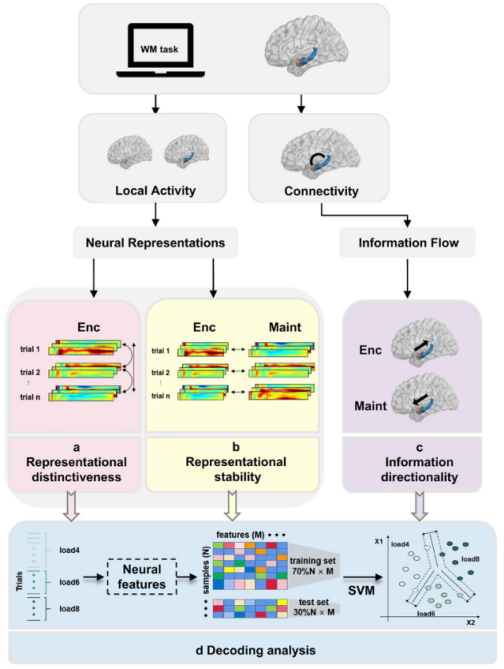
Figure 1. Study framework schematic. (a) Representation specificity of the amygdala and hippocampus during encoding; (b) Stability of representations across encoding and maintenance stages; (c) Information exchange patterns between amygdala and hippocampus during encoding and maintenance; (d) Decoding of working memory load using SVM based on these neural features.
First, using multivariate representational similarity analysis, the researchers quantified differences in representations between stimuli during encoding and found that the amygdala specifically encoded working memory information and could more accurately predict working memory load than the hippocampus (Figure 2(A)). Next, by examining representational stability across encoding and maintenance stages, they found that the hippocampus better maintained working memory representations during the maintenance stage and that its encoding–maintenance consistency was more predictive of working memory load than the amygdala's (Figure 2(B)). The researchers then used directed connectivity measures to analyze information flow between the amygdala and hippocampus during encoding and maintenance, discovering bidirectional information flow in the low-frequency band (1–40 Hz). Importantly, encoding-stage amygdala-to-hippocampus flow and maintenance-stage hippocampus-to-amygdala flow each enabled accurate decoding of working memory load (Figure 2(C)). Together, these findings reveal that functionally specialized neural representations and interaction patterns in the amygdala–hippocampus circuit support working memory processing across stages.
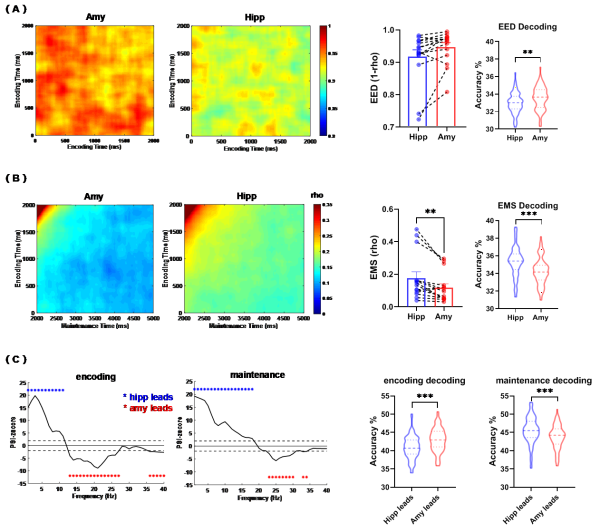
Figure 2. Main findings. (A) The amygdala specifically encodes working memory content during encoding, successfully decoding load information; (B) The hippocampus better maintains working memory representations during maintenance, successfully decoding load information; (C) The amygdala–hippocampus circuit shows bidirectional low-frequency (1–40 Hz) information flow, with encoding-stage amygdala-to-hippocampus and maintenance-stage hippocampus-to-amygdala flows both decoding working memory load.
In summary, this study systematically analyzed neural representations and information transfer patterns in the human amygdala–hippocampus circuit during working memory encoding and maintenance, revealing the circuit’s division of labor and cooperative mode that supports working memory processing. These results provide new evidence for understanding the neural mechanisms of working memory and offer new perspectives for studying disorders characterized by working memory deficits, such as schizophrenia and Alzheimer’s disease. Moreover, the study’s integration of intracranial EEG recording, multivariate analysis, and machine learning offers a new research framework for future brain–computer interface research and neurofeedback therapy.
The paper’s first authors are Dr. Li Jin (Associate Researcher) and Dr. Cao Dan (Assistant Researcher) from the Institute of Automation, Chinese Academy of Sciences. Researcher Jiang Tianzi and Prof. Johannes Sarnthein from University of Zurich are co-corresponding authors. Researcher Yu Shan, PhD student Xiao Xinyu, and others from the Institute of Automation also participated in the work. The study was supported by the National Key R&D Program (2021ZD0200200), National Natural Science Foundation of China (32271085, 82151307), CAS Pioneer Project (XDBS01030200), Key Lab of Cognitive Neuroscience and Learning Open Fund (CNLYB2004), Zhejiang Lab Major Projects (2022KI0AC02; 2022ND0AN01), and Swiss National Science Foundation (SNSF 204651).
Original Link:
https://doi.org/10.1038/s41467-023-38571-w
References:
Copyright Institute of Automation Chinese Academy of Sciences All Rights Reserved
Address: 95 Zhongguancun East Road, 100190, BEIJING, CHINA
Email:brain-ai@ia.ac.cn
