Research Reveals Common Mechanisms Underlying Recovery of Consciousness in Patients With Disorders of Consciousness
Font:【B】 【M】 【S】
A joint research team from the Institute of Automation, Chinese Academy of Sciences, Beijing Tiantan Hospital affiliated with Capital Medical University, Hangzhou Normal University, and the University of Liège in Belgium has recorded and analyzed brain activity patterns in patients with disorders of consciousness (DOC) of different ages, etiologies, and severities, and examined how these patterns relate to their recovery of consciousness. The study reveals a common neural mechanism underlying recovery of consciousness, providing key evidence for understanding this long-standing medical and scientific challenge. The findings were recently published in the international journal Nature Communications.
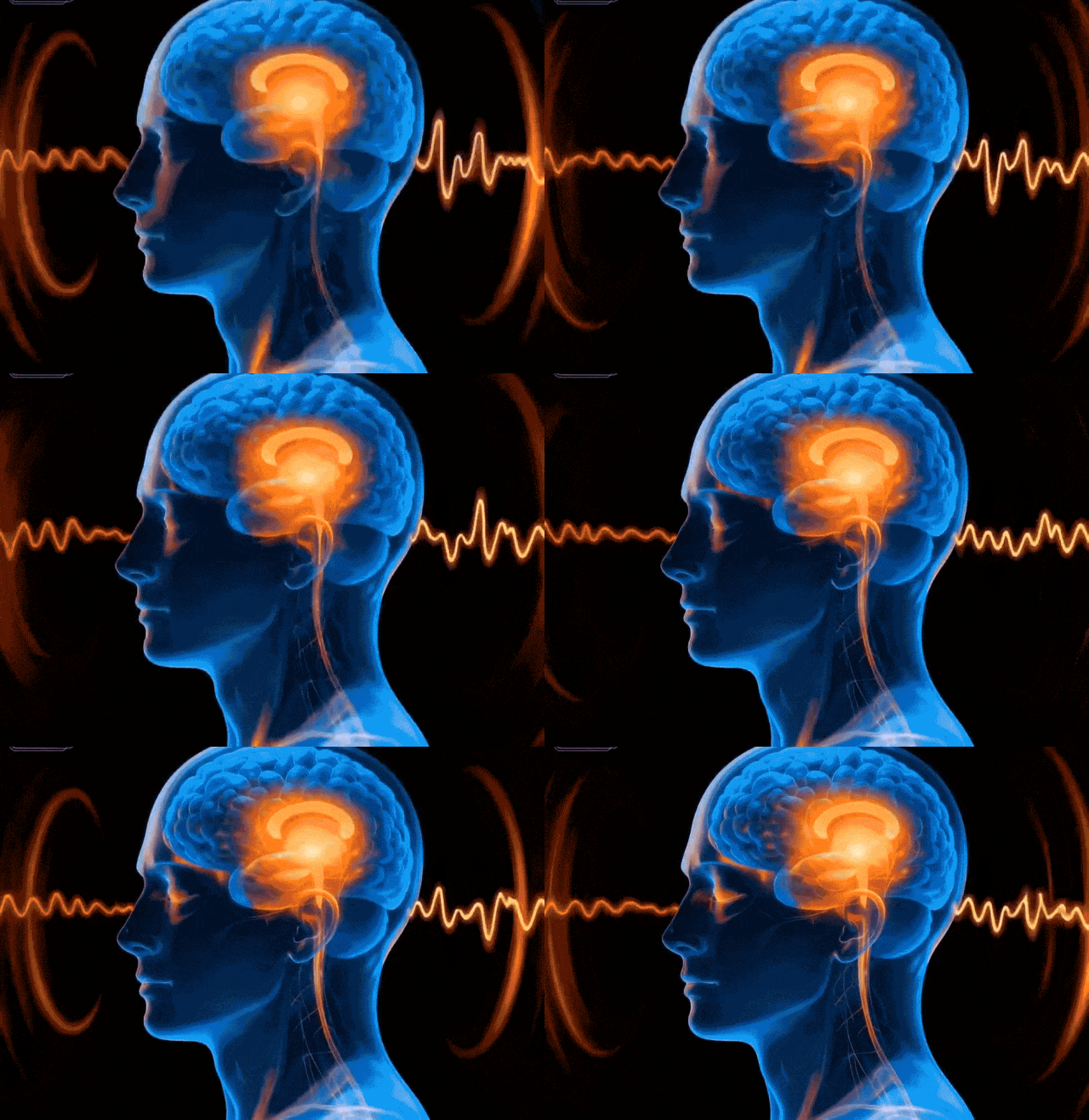
Conceptual schematic (image credit: Qi Chen)
Disorders of consciousness refer to the long-term loss or severe impairment of consciousness caused by severe brain injury. Patients in the most severe condition are commonly known as being in a “vegetative state.” In China, there are about one million patients with DOC, with 50,000–100,000 new cases each year, imposing a heavy burden on patients, families, and society. The etiologies of these conditions are extremely complex, including traumatic brain injury, stroke, and hypoxic–ischemic brain injury, with large variations in the extent and location of damage and substantial differences in prognosis across patients. For a long time, scientists have been asking: does there exist a unified recovery mechanism behind such a heterogeneous set of conditions? The answer to this question is crucial for developing more effective treatments.
By analyzing microelectrode recordings from 23 DOC patients who received deep brain stimulation, the research team used artificial intelligence techniques to deeply probe neural activity patterns in the thalamus, the brain region often described as the “consciousness switch.” From 34 electrophysiological features, the researchers identified four key features—most importantly, the strength and stability of 4–8 Hz neural oscillations (also known as theta rhythms)—and constructed a unified neural metric that is highly correlated with patients’ recovery of consciousness one year later.
The study showed that this metric has good prognostic value across patients with different etiologies, ages, and levels of severity. This means that, despite the large variability in causes and clinical presentations of DOC, their recovery is influenced by a shared neural mechanism.
The study further identified three types of recovery trajectories in DOC. The first group shows globally silent thalamic activity; all of these patients were in a more severe vegetative state, and none recovered. The second group exhibits higher theta power and consists mainly of patients who retained small but discernible signs of consciousness; more than half of them eventually recovered consciousness. The third group contains mostly patients diagnosed as being in a vegetative state, but with higher stability of theta rhythms. These patients represent a group of “covert recoverers”: although their clinical behavior appears poor, their thalamic activity still preserves an internal “spark” of recovery, and more than half ultimately recovered consciousness.
In the future, it may become possible to more precisely identify such patients, whose recovery potential is overlooked by conventional assessments, and provide them with tailored treatment, bringing new hope to patients and their families.
By building neural network models to simulate brain network activity during injury and recovery of consciousness, the team further explored the neural mechanisms of recovery. The results suggest that there may be two distinct dynamical pathways leading to recovery of consciousness.
In pathway 1, the strength of neural input recovers first, followed by the recovery of its stability. This corresponds to the typical pattern seen in the second group of patients. In pathway 2, the order is reversed: the stability of neural input recovers first, followed by its strength, matching the pattern in the third group of covert recoverers. Both pathways can eventually lead to recovery of consciousness, but they traverse different intermediate states.
This finding provides critical evidence for the widely discussed “ABCD” hierarchical classification theory of consciousness and offers new insight into why patients with similar clinical presentations can follow different recovery trajectories. Interestingly, the recovery mechanisms revealed in this study are highly similar to the transitions between different states of consciousness observed in earlier research on anesthesia and sleep, suggesting that different types of consciousness changes may follow a unified set of neural dynamics.
This study bridges basic neuroscience and clinical practice. It not only identifies a unified metric for highly heterogeneous DOC conditions, but also provides a scientific basis for individualized treatment strategies. Based on the unified metric derived from thalamic theta rhythms, clinicians can more accurately evaluate patient prognosis and design personalized treatment plans. For patients with different thalamic activity patterns, targeted neuromodulation strategies can be adopted to improve therapeutic efficacy.
At the same time, the research team is actively developing noninvasive assessment tools, aiming to use high-density electroencephalography and other techniques to noninvasively evaluate thalamic activity, and to build AI-based prognostic prediction systems. These efforts are expected to benefit a larger population of patients with disorders of consciousness.
Zhang Haoran, a PhD student at the Institute of Automation, Chinese Academy of Sciences, is the first author of the paper. Professor Yu Shan (researcher at the Institute of Automation, Chinese Academy of Sciences), Professor He Jianghong (chief physician at Beijing Tiantan Hospital, Capital Medical University), and Professors Steven Laureys (Hangzhou Normal University and University of Liège, Belgium) are co-corresponding authors. Ge Qianqian (PhD student) and Xu Long (associate chief physician) and Zhuang Yutong (PhD student) from Beijing Tiantan Hospital, Capital Medical University, as well as Professor Wu Si and PhD student Liu Xiao from Peking University, and attending physician Dang Yuanyuan from the General Hospital of the People’s Liberation Army are co-authors of the paper.
This work was supported by the National Key R&D Program of China (2023YFB4706100, 2022YFE0141300), the National Natural Science Foundation of China (82272118), the Beijing Natural Science Foundation (7232046), the Canada Research Chairs Program, European biomedical research funds, the King Baudouin Foundation of Belgium, and the International Mental Health Fund.
Copyright Institute of Automation Chinese Academy of Sciences All Rights Reserved
Address: 95 Zhongguancun East Road, 100190, BEIJING, CHINA
Email:brain-ai@ia.ac.cn
